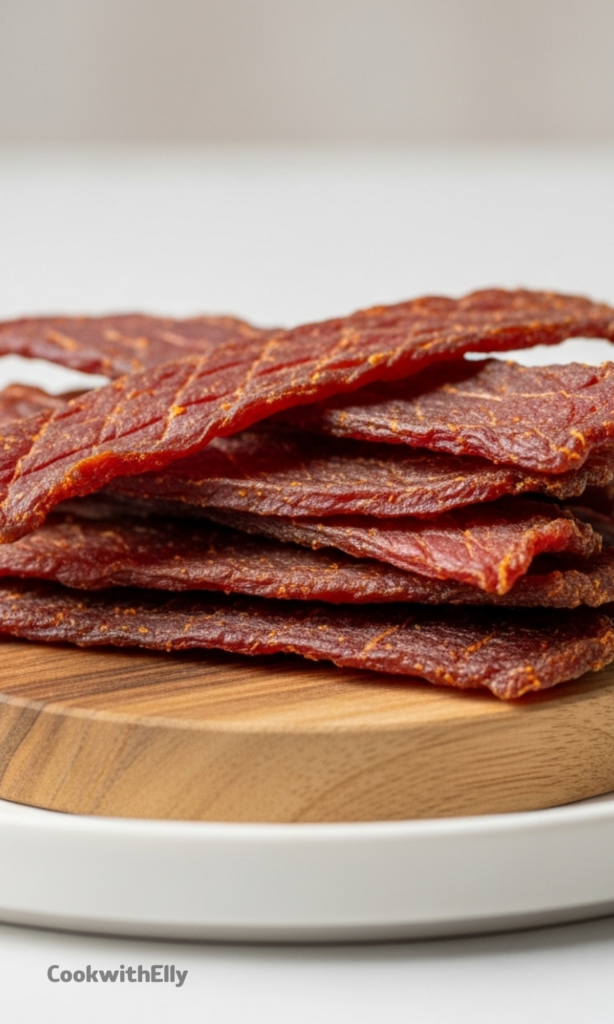
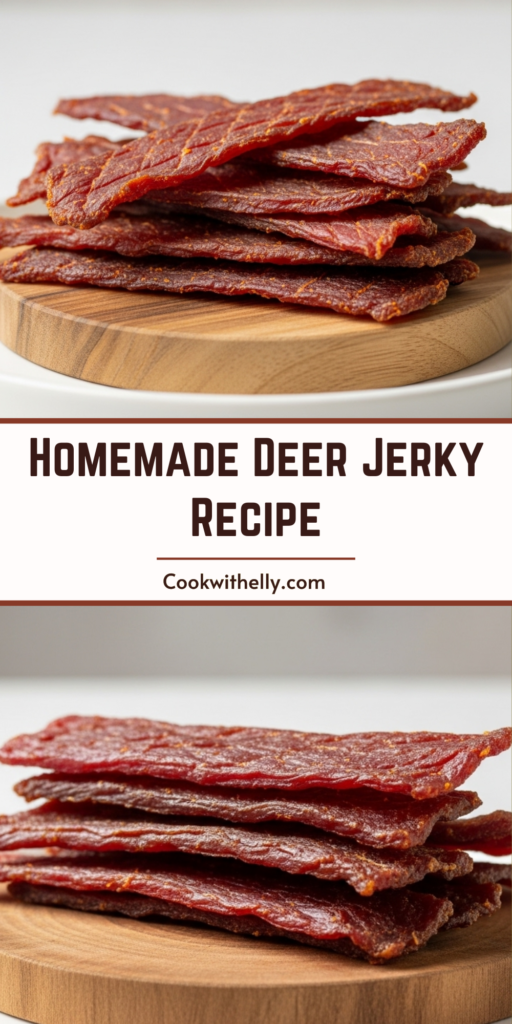
There’s something incredibly satisfying about turning a beautiful cut of venison into a shelf-stable, protein-packed snack you can take anywhere.
This recipe walks you through a classic, deeply flavorful marinade and a foolproof drying method, so your effort ends with jerky you’re genuinely proud of.
Why Homemade Jerky Beats the Store
Store-bought jerky can be a gamble, often loaded with sugar, mysterious preservatives, and a rubbery texture that’s more chew than joy.
When you make it yourself, you control the quality, the spice level, and the texture, creating something that’s not just food but a little piece of your own craft.
Ingredients Needed for the Recipe
Gathering your ingredients is the first step to success. Each one builds a layer in that perfect sweet, salty, and smoky profile.
2 pounds Venison: The star. Lean cuts from the rear leg or loin work best, yielding tender, non-greasy jerky.
1 cup Soy Sauce: This is your salty, umami foundation, the base that carries all the other flavors deep into the meat.
¼ cup Brown Sugar: A touch of sweetness to balance the salt, and it helps create a beautiful, almost glazed surface on the finished jerky.
2 tablespoons Worcestershire Sauce: Adds a complex, fermented tang that makes the flavor pop in a way you’d miss if it were gone.
1 tablespoon Garlic Powder & Onion Powder: The reliable backbone of savory flavor, distributing evenly throughout every single bite.
1 tablespoon Freshly Cracked Black Pepper: For a sharp, aromatic heat that’s noticeable but not overwhelming.
1 tablespoon Smoked Paprika: Gives a subtle smokiness and a rich, red color, especially if you’re not using a smoker.
1-2 teaspoons Red Pepper Flakes: The adjustable kick. Start with one, add more next time if you want that slow-building heat.
2 teaspoons Liquid Smoke: The secret weapon for that classic, campfire-kissed jerky taste without any special equipment.
½ teaspoon Instacure No. 1 (optional): For long-term shelf stability at room temperature, it’s a useful tool for hunters making large batches.
How to make ?
The process is simple, but the details here—the slice, the soak, the dry—are what transform good jerky into great jerky.
Make this recipe yours—just save it to your Pinterest board!”
Set aside an afternoon for prep, then let patience do most of the work overnight.
Step 1 - The Strategic Freeze
Take your thoroughly trimmed venison roast and pop it into the freezer for about 90 minutes.
You’re not looking to freeze it solid, just to firm it up tremendously, which makes slicing thin, even strips a world easier.
Step 2 - Whisk the Marinade
While the meat chills, combine everything else—soy sauce, brown sugar, Worcestershire, all the spices, and that liquid smoke—in a large bowl.
Whisk it until the sugar dissolves completely, creating a fragrant, dark brine that already smells like the finished product.
Step 3 - The Art of the Slice
Pull the meat from the freezer; it should be firm but not rock-hard. Slice it uniformly, about a quarter-inch thick.
Now, here’s your big texture choice: slice *against* the grain for more tender jerky, or *with* the grain for a traditional, chewy tear.
Marinating: The Flavor Infusion
Place all your meat strips into a large resealable bag or a glass dish, and pour the marinade over the top.
Seal it up, massage the bag to coat every piece, and let it rest in the fridge. Six hours is good, but twenty-four is transformative.
Step 4 - The Patient Soak
This is the waiting game. Tuck the bag into the back of your refrigerator and let the magic happen.
If you remember, give the bag a gentle turn or shake once or twice to redistribute the flavors, but really, the fridge is doing all the work.
Step 5 - The Critical Dry-Off
When the marinating time is up, drain the strips in a colander. Then, lay them out on a tray lined with paper towels.
Pat them dry, really dry, on both sides. This step is crucial for proper dehydration, not steaming, in the next phase.
Step 6 - Rack 'Em Up
Arrange the strips on your dehydrator trays, or on oven racks if you’re going that route, ensuring they aren’t touching or overlapping.
Good airflow around each piece is non-negotiable; it’s what ensures even, consistent drying from edge to edge.
Step 7 - The Two-Stage Dehydrate
Start your dehydrator at 165°F for three hours. This higher initial temperature is important for food safety.
After that, reduce the heat to 145°F. Let them go for another hour, then start checking for doneness.
Testing for Perfect Doneness
The “bend test” is your best friend here. Take a piece off the rack and let it cool for a minute.
Bend it; it should be pliable, cracking slightly but not snapping in two, with no visible moisture when you tear it.
Step 8 - The Final Cool Down
Once perfect, turn off the dehydrator but leave the jerky on the racks for a few hours to cool completely.
This resting period allows any last residual moisture to even out, guaranteeing your jerky will store perfectly.
Tips
For easier clean-up, line the bottom of your dehydrator with parchment paper to catch any drips during the first hour of drying.
If using the oven, prop the door open with a wooden spoon to allow moisture to escape, preventing the jerky from baking instead of drying.
Store your cooled jerky in a paper bag for a few hours before sealing it in an airtight container; this helps absorb any last trace of surface moisture and prevents condensation.
Creative Flavor Twists
Once you’ve mastered the classic, don’t be afraid to play with the marinade. It’s your canvas.
Try swapping the soy sauce for teriyaki, add a splash of bourbon, or mix in a tablespoon of gochujang for a sweet, spicy, and funky twist.
Storage and Shelf Life
Properly dried jerky is a marvel of preservation. Kept in an airtight container in a cool, dark pantry, it’s good for up to two months.
For long-term storage, vacuum-seal it and it will last for months in the fridge, or even longer in the freezer, ready for your next hike or hunt.
Deer jerky is arguably the best and most convenient hunting season snack. The marinade used in this recipe is packed with flavor and balances sweet and savory. Follow these foolproof instructions to make great venison jerky every time—perfect for backpacking, road trips, or a healthy protein-packed snack at home.
ingredients
2pounds venison (eye of round, top round, or sirloin, thinly sliced)
1cup soy sauce
1/4cup brown sugar
2tablespoons Worcestershire sauce
1tablespoon garlic powder
1tablespoon onion powder
1tablespoon freshly cracked black pepper
1tablespoon smoked paprika
1-2teaspoons red pepper flakes (adjust to taste)
2teaspoons liquid smoke
1/2teaspoon Instacure No. 1 (optional for shelf stability)
Instructions
1
Remove silver skin from your venison. Place the meat in the freezer for 1–2 hours or until partially frozen for easier slicing.
2
In a large bowl or ziplock bag, mix soy sauce, brown sugar, Worcestershire sauce, garlic powder, onion powder, black pepper, smoked paprika, red pepper flakes, liquid smoke, and Instacure No. 1 (if using).
3
Slice the meat into ¼” strips—against the grain for tenderness or with the grain for chewiness.
4
Add the venison slices to the marinade, ensuring all pieces are fully coated. Refrigerate for 6–24 hours, shaking or turning occasionally.
5
Pat the slices dry with paper towels to remove excess marinade.
6
Arrange the strips on dehydrator racks, leaving space between each piece for proper airflow.
7
Dehydrate at 165°F for 3 hours (to ensure food safety), then reduce heat to 145°F. Continue drying for another 3–5 hours, or until jerky bends and cracks without breaking.
8
Allow jerky to cool completely for several hours before storing in an airtight container. Store in a cool, dry place for up to 2 months, or refrigerate for longer shelf life.
Nutrition Facts
Servings 8
Serving Size 1 oz (28g)
Amount Per Serving
Calories150kcal
% Daily Value *
Total Fat4gg7%
Saturated Fat1.5gg8%
Trans Fat0gg
Cholesterol60mgmg20%
Sodium980mgmg41%
Potassium420mgmg12%
Total Carbohydrate6gg2%
Dietary Fiber0gg0%
Sugars5gg
Protein22gg44%
Calcium 20 mg
Iron 2.5 mg
* Percent Daily Values are based on a 2,000 calorie diet. Your daily value may be higher or lower depending on your calorie needs.
Note
Freezing tip: Slightly freezing the meat makes slicing much easier and more uniform.
Marinating time: For deeper flavor, marinate up to 24 hours—but never less than 6 hours.
No dehydrator? Use your oven at the lowest setting (~175°F) or a smoker at 160°F for 3–4 hours.
Storage: For long-term storage or hot climates, refrigerate or vacuum-seal.